Your Custom Text Here
Twenty-Five Years Later

It’s a common phenomenon. I can’t always remember what I did yesterday but I remember an example my history teacher gave in class two decades ago. I’ve been told by friends that I have an amazing memory. I’m not sure if that’s true but I do have a knack for remembering random details about things and events most people have forgotten. Things like high school class schedules, the books read for certain college classes, and random conversations. I will often say in a Marco Polo to a friend, “Hey do you remember that person in high school and one day this happened in class and…” She will usually reply with, “No.” But I can see it clear as today.
Even if you have a bad memory, if you were older than a toddler in 2001, you probably have memories of the morning of September 11. There are some moments that defy forgetting if you experienced them. I’m sure Pearl Harbor and JFK’s assassination are other examples. They are so shocking, so unexpected that your brain is unable to filter them away. Memories will unexpectedly come to the surface with a reference, a video, an anniversary.
In the case of September 11, it wasn't just a random place for me. I had been in New York City in May of that year. Part of my high school choir had traveled to perform in a larger choir at Carnegie Hall. We went sightseeing between rehearsals, saw a Broadway show, and shopped. One afternoon we took a boat to the Statue of Liberty. On our way back to Manhattan, I clicked a picture of the skyline, the Twin Towers in full view.
I was leaving math class on 9/11 when I noticed everyone huddled in groups whispering and solemn. When I got to my English class and heard the Twin Towers had been hit and then the Pentagon, the full force hit me. In my mind, evil seemed close.
To demonstrate what a different place the world was before that morning, when we visited NYC as a choir, our director literally turned us loose. We had to stay in groups of three but me and two friends took the subway to Rockefeller Center, walked through Bloomingdale's, and rode the escalator in Saks Fifth Avenue. Three 17 year old girls, wandering the city alone. No phone, no GPS. Just watches and a rendezvous time to be back at the hotel.
The reality of what happened on 9/11, and happened so quickly, took much of that innocence and trust out of the world. Yes, the world was dangerous before, but it didn't feel like it. You could ask a stranger for directions and they would help you. People made eye contact and smiled. You could start a conversation with a person on the subway and they would usually engage politely. There was a general kindness between people, even in a city like New York.
That day wasn't just full of loss. It was brimming with uncertainty. Things that seemed like they would always happen stopped. Airports stood still as planes were grounded indefinitely. In a world before cell phones were the norm, people waited for news, waited for family to get to a phone. Photos of the missing lined streets, plane manifests were released. It wasn't just September 11. It was the weeks following when everyone was raw and on edge and waiting for what impossible things would come next.
As I sat in English, listening to the radio reports, I remember looking around. Even the class cut ups who were usually talking in the back of class were silent, staring at the blackboard with unblinking eyes. Our teacher, who was rarely quiet or still in class, stood to the side, hands covering his mouth and staring so intently at the radio, it was almost as if he was willing the news to change. At the end of class, we prayed and filed out, silent. I met friends in the hall and we hugged and cried together.
When I talk about that day with my kids, I still cry. When I see footage, I get a sick feeling in my stomach, in a way still not believing it's real. But it was. Nine months after, I found myself in NYC again, this time on a mission trip. On a Sunday evening, we took the subway from Brooklyn and quietly walked to where the Towers had stood. It was a giant hole, fenced off. A crew still worked to continually remove the rubble. Photos of the lost were displayed in makeshift memorials. Flowers and candles were placed at different intervals. There was no talking, not because people were enforcing a rule but because you felt the weight of the place. There were no words adequate to say.
Today there are many words to express what that day felt like and took from people and changed, but I still come up short to communicate the full sense of sorrow I feel on these anniversaries. And maybe that's something worth considering. That it is good for us to sometimes remember with silence and a prayer.
Photo by Andrew Ruiz on Unsplash
Fitting the Pieces Together

Over the last few years, I have enjoyed puzzling. By this I mean working puzzles. I have strangely found it relaxing, sitting at a table and sorting pieces by shape or color, taking time to notice details and reach for that missing piece. When my kids want to watch a movie I’m not interested in, I’ll sit in the back of the room, sipping tea and puzzling. When I need a minute to myself, I’ll turn on an audiobook and get lost in the story and sorting pieces. We now have a round table in the basement affectionately called the puzzle table, although we do sometimes have to move my setup and use it for other things.
However, I have found I’m somewhat particular in my preferred puzzles. I have one puzzle that’s 2000 pieces and it almost broke me. I generally reach for 750-1000 piece options. I like beautiful pictures or something sentimental. Or cats and flowers. Anything with a cat or flowers. I have worked a few mystery puzzles, where you don’t know what the end result will be and those are fun.
As I’ve sat in my chair, turning over pieces, scanning the scene of already completed portions, I noticed many similarities between working a puzzle and studying the Bible. Of course, like all analogies, it falls apart in some places but I found it very helpful to think through this way.
Some pieces seem confusing until you view them in the whole puzzle.
Often, as I’m beginning a puzzle and sorting pieces by color or edge, it’s impossible to tell what that piece represents. Is this black piece part of the cat or the night sky? We don’t know until we put other pieces together and can see where it fits in the whole. When we study the Bible and we only focus on certain books, some of the accounts seem strange. Why did God give us page after page of cleansing rituals in Leviticus? Why does Judges record such evil and hard to read stories of wickedness? When we read chapters or verses or stories in isolation, it’s like looking at a piece of a puzzle and deciding it’s not necessary because it doesn’t look like anything else in the puzzle.
This verse could be the theme of the entire blog post but II Timothy 3:16 says, “All Scripture is breathed out by God and profitable for teaching, for reproof, for correction, and for training in righteousness.” ALL Scripture. Every section that is included, God preserved for a purpose. The pieces might seem strange in isolation but they all point to who God is and the redemption story woven throughout the Bible. The seemingly random lists of rituals show how God wanted his people to live differently than the other nations. God is holy and perfect and he wanted his people to live in light of that reality. The stories of evil in Judges give proof to what happens when everyone does what is right in his eyes instead of living by God’s commands. They also serve as a contrast to Ruth in the next book.
Just as we don’t discard puzzle pieces we don’t think are necessary, we should never discount parts of the Bible as unimportant because we don’t understand them or they make us uncomfortable. God preserved His Word the way he chose.
All the pieces are important.
This ties in with the first point but it’s worth repeating. One of the most frustrating things in putting a puzzle together is when you are missing that final piece. It’s enough to make you feel crazy. You start crawling on the floor, looking under every possible thing, interrogating your family to make sure no one carried a piece away {yes, that’s happened to me}. Even though you can see the final picture fine without that one piece, it’s frustrating! And so it is in Bible study when we forget that all 66 books form one cohesive story. Maybe we can recognize the redemption arc through the Old Testament and how it foretells the Savior coming to save us. But there’s that one story that bothers us so we want to cut it out of the biblical narrative. It doesn’t fit our 21st century minds so clearly it’s not worth studying and it doesn’t matter because we still believe in salvation!
Don’t be trapped into this thinking! Again, God in his sovereignty preserved His Word just as he wanted us to know it. He could have given us more, he could have given us less. He could have taken out the bits that make us scratch our head. But he didn’t. Every word of the Bible is inspired — literally God breathed — and therefore deserves our attention. Even if we know what the picture looks like, we want to find and place every piece where it belongs.
Border pieces serve a purpose.
I’ve never worked a puzzle with someone who didn’t put the border up first. These edge and corner pieces are distinct because one side is flat; you know they go around the perimeter of the puzzle and all the other pieces will fit inside. In terms of Bible study, while we read various passages and dig deeper into specific parts, we need to keep in mind our border pieces or framework. We know the whole of Scripture fits together and it is ALL profitable, valuable, etc. {II Tim 3:16}. When we read something that confuses us, instead of discarding it we need to return to our border pieces. I like to think of the border as two truths: the over arching story of redemption and who God is. When we view all the interior pieces, every verse that makes up those 66 books in the Bible, we come back to these two things that are containing them {much like the border of the puzzle}.
Why are they important? Because they help us understand why certain events and people are given space in the Bible. When we read the laws for offerings and cleansings in Leviticus and the complete wickedness happening in the time of the Judges, it’s easy to say those don’t matter today and we can ignore those books. However, ALL Scripture is profitable for teaching us so we ask what the lesson is. When we consider these books in the framework of asking, "What does this tell me about God” instead of, “What am I supposed to do with this” it keeps us from throwing out portions we don’t like. Because all the Bible shows us something about God and his plan of redemption.
Leviticus teaches us God’s holiness cannot abide sin and he wanted {and still wants} his people to be set apart and different from the world. If the heathen culture was doing it, you don’t! We must keep in mind, Israel had been in Egypt for 400 years. They were surrounded by idolatry, pagan worship practices, and temple sacrifices to false gods. In Leviticus, God is telling them how he will be worshipped and how he wants them to live. And even though we don’t practice sin offerings or uncleanness until evening standards, these things should humble us to realize how serious sin is and how holy God is. Judges shows what happens when we forget God and everyone lives the way he wants. It shows people standing up against the culture for God and how God uses them. It shows how wicked people can be when they choose to wallow in sin. And it also shows God’s faithfulness. Israel abandoned him again and again for other gods, but he continued to send judges to rescue them physically from their enemies {think Samson, Gideon} and to point them toward their need of a perfect Judge {Jesus}.
Remembering these border pieces keep us grounded when we study and keep us from looking to ourselves for the reason a passage is important. It’s not about us; it’s about God.
You can’t judge the full puzzle from one piece.
If I handed you a blue puzzle piece and asked what the puzzle looked like, you might say a picture with sky or an ocean. But maybe it’s actually a city scene and the blue is a shop window. Even if the piece I handed you had a clear outline of a dog, that doesn’t mean the entire puzzle is about dogs. It might be a park with a dog walking through it. You really can’t get a feel for the whole by just looking at one piece. And so it goes in Bible study. So many people look at one thing, such as God commanding the Israelites to wipe out the Canaanite nations, and immediately shake their heads. “God is too mean, too vengeful. He isn’t loving, he can’t be trusted. God in the Old Testament is a bully.” And they come to that conclusion through misunderstanding one text and not considering the message of the Bible as a whole.
Remember we talked about border pieces? A border is more than just one piece and God is much more than one attribute. In the above example, the Canaanites had been doing their thing for hundreds of years and chose to not turn to God. They sacrificed their children to false gods and did all manner of wickedness in the name of worship. God kept judgment from them for generations and nothing changed. Sin has consequences and God will judge. But consider the mercy of God in the account of Ruth. Ruth was not an Israelite but a Moabitess. She chose to leave the idolatry that her people practiced and serve God {Ruth 1:16}. God blessed her and not only provided her and Naomi with food and provision through Boaz, but God also made her descendants future kings {David, Solomon, etc., Ruth 4:22} and the Messiah {Jesus, Matt. 1:5}.
It is a great injustice of ours to limit God to what we observe in one passage or story in the Bible. The whole Bible speaks to who God is and God doesn’t go against himself. If one passage demonstrates God is omniscient {think of when God told Abraham that Sarah would have a son in Gen. 18:10-15, 21:1-3} and another passage shows his mercy {God saved Rahab and her family from destruction in Josh. 2:12-14, 6:25}, we need to recognize that both those attributes are part of God’s character. God is multifaceted and there are parts of him we won’t fully understand this side of heaven. And it’s a good thing! If we knew everything about God or everything he knows, we wouldn’t have a very powerful God!
Just as a puzzle’s full picture and beauty isn’t revealed until you can see the entire thing, we don’t see a full view of God or his redemptive plan when we focus on only parts of His Word. The individual pieces can be confusing or misinterpreted unless we take an overhead look.
It takes time, dedication, and patience.
This last point is important to remember when you get frustrated. Unless you are working a child’s 24 piece puzzle, it will take time and patience. Usually the first time I sit down to a new puzzle, I am only sorting pieces, looking for edges and corners, and flipping all the pieces to right side up. My children have been known to wander past the table at some point and say, “You haven’t even started? What have you been doing?” It looks like it wouldn’t take long and piles of pieces sorted by color or shape and edge aren’t exciting when you want to see the completed result. However, this initial time is crucial to the success of your puzzling and it lessens your overall frustration at hunting for pieces later.
When we think about Bible study and Christian growth, there are no shortcuts. We can read other books and resources, listen to sermons and podcasts, watch interactive videos. But we won’t really “get it” or see the full beauty of the Gospel if we aren’t regularly in our Bibles for ourselves. I’ve attended church my entire life, gone to Bible studies, taken Bible classes in high school and college. But some of my biggest “a-ha!” moments have come when I’m reading the Bible on my own. It’s the daily exposure, the slowly reading and taking notes and making observations that will truly make everything click. But just as you can’t pour the puzzle pieces onto a table and have them magical build the puzzle, you can’t read isolated passages — or worse never read the Bible — and expect to understand what those passage mean and how they connect to everything else.
I have never regretted time reading my Bible. In fact, I have a whole list of people, passages, and themes that I want to dive deeper into. But as you read and study, don’t get so hung up on one piece that you quit reading and start making ignorant statements about what the Bible does or doesn’t say. Keep reading. Keep clicking the pieces together. God wants you to know him and understand His Word and he will help you. One piece at a time.
Photo by Hans-Peter Gausteron Unsplash
Bible quotations from the ESV {English Standard Version}
How We Treat Others
One of the first things you teach a toddler is sharing. It’s a hard lesson to learn! The idea of thinking of someone else and putting what we want behind the desires of others is completely foreign until it is taught. Even a very sweet tempered, kind child in personality has a drive to look out for herself, grab what she wants.
But life and living with others is about so much more than ourselves. To live in peace with others means we won’t always get our way. And it means people won’t always agree with us. This idea of getting along with others isn’t just a societal, polite construct. It is a biblical tenant that allows us to show others how knowing Christ changes us from the ways of the world.
The goal of most people in today’s society is self preservation. Do what feels right to YOU. Live YOUR truth. Follow YOUR desires. Fulfill YOUR dreams. Do what YOU want. It’s all self driven and keeping YOU in the center. It doesn’t matter if you offend someone, but someone better not offend YOU! It doesn’t matter how you treat others but people better treat YOU well! We are all not only the heroes of our stories but we are the center of the universe, at least to ourselves. And this attitude is far from what the Bible presents to us.
The Westminster Catechism is a summary of doctrine for Christians. It is hundreds of years old and has been used to teach people Bible doctrines in a simple and easy to remember way: questions and answers. The very first question in the catechism is: What is the chief end of man? Answer: Man’s chief end is to glorify God and to enjoy Him forever. Several texts that this idea comes from are Romans 11:36; I Corinthians 6:20, 31; Revelation 4:11; Isaiah 12:2; Revelation 21:3-4. Clearly, we were not created to think of ourselves first. We are here to bring glory to God, no matter what that looks like in our lives.
But the Bible not only tells us we were created to glorify God, but also that we are to get along with other people. In the Sermon on the Mount, Jesus said, “So whatever you wish that others would do to you, do also to them, for this is the Law and the Prophets” {Matthew 7:12}. That phrase “the Law and the Prophets” refers back to the Old Testament and what God had told the children of Israel to live by. This wasn’t Jesus bringing new information. This was him confirming that the Old Testament was still valid then and is still for us today.
It’s fairly easy to think about how we want to be treated. With kindness, respect, care, humility, dignity. We probably don’t want to be yelled at or put down or called names. But it’s so natural to think that the way we treat people isn’t affecting them because we enjoy telling the jokes or the sarcasm. Possibly we don’t think they deserve kindness or respect because of past faults, stereotypes, or just plain meanness.
I’m not going to get all politically correct here, but when I was younger, I had white blonde hair. I was more blonde than Barbie and it stayed that bright until almost Jr High. I probably don’t have to tell you how many blonde jokes I’ve heard over the years. And the people telling me were friends, people I knew, people who were trying to be more funny than mean, but I still remember it hurt. And I think as a child, it was especially hurtful because I didn’t understand why people would tell jokes about how dumb I must be based on my hair color. My confidence growing up wasn’t stifled just because of the jokes — I always knew I wasn’t the best, smartest, etc. But it certainly wasn’t helped either, feeling like when I made a mistake, I was proof of the dumb blonde stereotype.
However, just because I’ve struggled with how people have treated me doesn’t mean I’m always making the right choices on how to treat others. I’ve said plenty of things I regret, snapped at someone when it wasn’t needed, made a criticism in a less than loving way. And I’m always convicted when I don’t treat others with the respect I should. Is there a time to be firm in the truth, even at the cost of offending someone? Absolutely. If we are calling out sin and evil, we will offend the world. But do I think we ever need to resort to name calling, yelling, bullying, or violence? Nope. We can share Gospel truth without stooping to the level of the culture. The way we treat others, from the tone of voice to the words we choose, is a reflection of the God we say we serve.
Consider this from II Corinthians 13:11, “Finally, brothers, rejoice. Aim for restoration, comfort one another, agree with one another, live in peace; and the God of love and peace will be with you.” Christians should not be trying to pick fights or always insist on being right. Remember that Paul is writing to the Corinthian believers here and this is the second letter that he has had to confront them on some things. They were not living according to God’s standards in how they lived and apparently, how they treated each other. So Paul closes his letter with this, and you can almost sense Paul sighing that this is the last exhortation for them. When possible, without compromising the truth of the Gospel, we are to live in peace with other Christians.
Romans 12 is another chapter to consider in terms of instructions on how believers should live with others. Here we read about the body of Christ and the importance of each member in the body {vv4-5}. But starting in verse 9 through the end of the chapter, we see short phrases that seem simple in what they say but pack a punch when you consider how they should play out in our lives.
“Let love be genuine. Abhor what is evil; hold fast to what is good. Love one another with brotherly affection. Outdo one another in showing honor” {vv9-10}.
“Bless those who persecute you; bless and do not curse them. Rejoice with those who rejoice, weep with those who weep. Live in harmony with one another. Do not be haughty, but associate with the lowly. Never be wise in your own sight. Repay no one evil for evil, but give thought to do what is honorable in the sight of all. If possible, so far as it depends on you, live peaceably with all” {vv14-18}.
All of these can be summed up with, “Think of others before yourself” which is completely counter cultural. How we treat others says a lot about what we value. It also reflects on how we view God and His creation. Instead of the me first, I’m right and you’re an idiot talk, we need to treat others with kindness, handle disagreements rationally, and stand firm in the truth of the Bible.
Bible quotes are from the ESV Bible.
Photo by Erwan Hesry on Unsplash
The Idol in my Kitchen

When we moved into our home in 2018, we knew there were things we would eventually like to change. The location and overall layout of the house were just what we wanted but the kitchen had a few quirks. We knew the countertops needed replacing and the floor was breaking in a few places but we didn’t want to spend money on those until we knew what else might need to be addressed.
We started saving money. We began writing down ideas. We asked what was possible to change and what we needed to make work. And we waited. To be honest, it sometimes felt as if it was the project that would never be. But finally, last summer the demo happened. Cabinets, floors, the fireplace stone were all ripped out. Electrical and plumbing were exposed, walls came down. And slowly over six months, the kitchen was put back together.
I didn’t know that so many decisions could exist in the world but we found them all and sorted through things I’d never thought about! Not just the big decisions like appliances and flooring and cabinet color. But which drawer I wanted my knives in, where I would store the cutting boards, what counter the mixer would be on. Where did I want outlets? How many outlets on each wall? Where did I want the light switch for the under cabinet lights? Which side did I want the garage disposal in the sink? Did I want adjustable shelves in the pantry or fixed? How many cabinet doors opposed to cabinet drawers? Thankfully, we had an experienced team who we knew and trusted and they navigated the questions and options and gave advice. We couldn’t have ended up with the kitchen we did without them! They are heroes!
After six months without a kitchen, eating dinner in the basement from a Crockpot most nights, the day our contractor said goodbye was filled with anticipation and joy. What would we make first?! We could bake, blend, fry, whatever we wanted! We moved utensils and pans to their new spaces and filled up the pantry and fridge. When the kids came down the first morning, they wanted to fix bacon and eggs for themselves. It tasted glorious!
But as I continued to fill our new space and load all the drawers and shelves, a strange feeling of fear crept over me. All the waiting, all the money, all the time. I wanted to be a good steward of the amazing blessing this kitchen remodel was and I wanted to keep it as nice as possible. But I also know how messy cooking is. How was I going to use this space AND keep it perfect? The first few weeks, my family probably thought I had been replaced by a neat freak. A knife with peanut butter would be put on the counter and I would zoom in to clean the knife and wipe the counter. I might have burned myself a time or two with my over zealous need to wipe down the stovetop when it was still warm. I tiptoed around the kitchen, afraid of spoiling it.
One Sunday, I was chatting with a friend who had redone her kitchen the year previous to ours. I lamented how stressful it was to cook now because I was afraid of ruining the things we had saved and waited for. I concluded with, “Who knew a kitchen remodel would bring an idol into my life?” And it struck me with sudden clarity that the kitchen — or maybe the desire for a perfect kitchen — had become an idol. My fear of damaging or misusing something was driving my joy. The whole point of our remodel had been to create a space our family could cook in and instead of gratitude that it had been accomplished, I was afraid it might look like we were using our kitchen! The irony was not lost on me.
Idols are sneaky because something good {family, friends, home and things in it, work} can become idols if we begin valuing them more than the One who gave it to us. When our identity, our joy, our purpose is wrapped up in something else, it quickly starts to control us and how we interact with others. That’s idolatry.
I believe there is a balance. We can be good stewards of the gifts God has given us without veering into elevating those gifts beyond their value. But it takes effort and sometimes it takes a realization that we have gone too far. I’m not neglecting the cleaning of my kitchen to show it holds no power over me. But I am giving my kids space to bake and use the kitchen without hovering behind them, waiting for the mess I will immediately clean. I still wipe my counters and stovetop more often than I used to, which is probably a good thing. But I’m not obsessing over messes that might happen or ignoring the joy my beautiful kitchen gives our family. I’m reminding myself it’s a gift to use and enjoy. And that is what we are doing.
Photo by Collov Home Design on Unsplash
Who Are You Listening To?
In my Bible reading, I recently came across a story that I have read before but it gives me pause every time. In II Samuel 10, we read that the king of the Ammonites died and his son became king. David, in a gesture of kindness, sent some of his servants to the new king “to console him concerning his father” {v2}. However, the new king, Hanun, listened to bad counsel and humiliated the servants of David {vv3-5}. When King Hanun realized his mistake, he decided to strike before David could. He called up the Arameans to join him and marched against Israel. It didn’t go well and Israel defeated both kingdoms {vv8-15}.
All this from listening to bad advice. The thing is, we are all susceptible to this at different times. And because all people are sinful, we need to be discerning. This obviously includes who we choose for friends but also who we choose to listen to in the broader sense. Authors, experts, analysts, pastors, teachers. A lot of people can sound smart and convincing but charisma doesn’t equal biblical advice.
Proverbs has much to say about who we follow and who should have our attention.
“The way of a fool is right in his own eyes, But a wise man is he who listens to counsel.” {12:15}
“He who walks with wise men will be wise, But the companion of fools will suffer harm.” {13:20}
“Deceit is in the heart of those who devise evil, But counselors of peace have joy.” {12:20}
Allowing good, godly advice to lead us is equated with righteousness and wisdom. The opposite is to listen to fools. I can’t think of anyone who would willingly listen to a fool but fools are often disguised. We need to be discerning with wisdom of our own.
And Proverbs has things to say about discernment also!
“My son, let them {knowledge/wisdom} not vanish from your sight; Keep sound wisdom and discretion.” {3:21}
“The mind of the prudent acquires knowledge, And the ear of the wise seeks knowledge.” {18:15}
“For if you cry for discernment, Lift your voice for understanding…Then you will discern the fear of the Lord And discover the knowledge of God. For the Lord gives wisdom; From His mouth come knowledge and understanding.” {3:3, 5-6}
Discernment comes from wisdom. When we hear anything — especially something labeled as biblical — we need to go back to the Bible and discern if it is truthful. Many things in today’s world have a grain of truth or sound really nice, but when we dig a little, we find inaccuracies.
I’m not saying to distrust everyone and only listen to yourself. But we should be knowledgeable enough in the Bible to hear when something sounds off and start asking questions. It doesn’t matter how popular the podcaster is, it doesn’t matter what letters are behind the pastor’s name, it doesn’t matter how many books the author has published. We need to consume any teaching with discernment and wisdom.
And James gives us a huge dose of encouragement here:
But if any of you lacks wisdom, let him ask of God, who gives to all generously and without reproach, and it will be given to him. {1:5}
We aren’t mustering and striving to have wisdom on our own. The God of the universe will give us the wisdom we need if we ask! If we want wisdom, may we humbly ask for it as Solomon did and God has promised to give it.
Maybe it’s not a question of who we listen to as much as who do we believe? Who do we follow and submit to? Who are we giving our time to? May it be the God of wisdom first and above all else.
Photo by Annie Spratt on Unsplash
The One Anothers
For all the connectedness we have, our society is more isolated than ever.
We sit behind keyboards and phones, “connecting” with others over the internet but only seeing what people want us to see. Algorithms make sure we are fed content we like and enjoy, creating echo chambers of agreement and anyone who disagrees isn’t worth keeping up with. We have people making emotional connections to an AI program! And we wonder at the state of things.
Throughout the New Testament we have what’s often referred to as the one another statements. These teach us about an important aspect of our Christian life: how we treat others. But it goes deeper than “Love your neighbor” because before we can truly love and care for those around us, we have to BE with them. We have to do things with them, live life, enjoy the ups and downs and still be friends. It’s not easy or glamourous but being in community is so important.
In the one another verses, we find statements like, “Forgive one another, bear one another’s burdens, encourage one another, exhort one another, comfort one another,” and I could go on. These are specific and go far beyond “love one another” to the daily grind of living life together.
In order to comfort others, we need to know them well enough to know when they need to be comforted. If there’s a health crisis, a family need, a sudden tragedy. Offering comfort can come through texts and cards, but it needs the personal touch of being in each other’s lives.
The one another statements are interesting because there are some verses that tell us what not to do. “Do not grumble against one another, do not speak evil against one another, do not provoke one another, do not lie to one another,” etc. These verses remind us that thinking of others isn’t always about doing something; sometimes it’s about not doing what our sinful nature wants us to.
There is a vulnerability in living these things with others. Do you have friends close enough that you feel like you can share your burdens? Do you forgive and work through differences?
These biblical statements and principles are reminders that this life isn’t about us, and the greatest things we do aren’t for ourselves. We are to live in community and grow and serve each other.
Photo by Jon Tyson on Unsplash
Why is Prayer so Difficult?

I have been thinking about my prayer life recently and prayer in general. Prayer seems like an obvious, simple part of the Christian life but I know I often struggle with it. Why is prayer so hard at times? Here are a few challenges I’ve faced and am still working through.
No Time
Prayer is something that we often say we don’t have time for. When I imagine myself not having time to pray, I’m thinking of sitting in a chair for an hour. Yes, in that moment it’s easy to say I have no time for that! However, we see in I Thess. 5:17 the simple verse, “Pray without ceasing.” And we have to acknowledge that can’t mean walking around with eyes closed 24/7, but God wouldn’t give us something impossible to do so…. I’ve heard it said this way — we are to continually, as things pop in our minds or happen around us, bring them to God in prayer. I have started praying a quick prayer for the day before I get out of bed in the mornings. I will pray for specific people before I read my Bible. When I hear of a need, I stop and pray for just that request. We somehow have in our minds that prayer doesn’t “work” unless we are on our knees. Yes, we need to make time for structured prayer {more on that below} but we can also be sending on-the-spot prayers up all day! Consistency builds a habit that slowly becomes natural.
No Thought
This sounds like a weird one but let me explain. I was having a conversation with one of my children the other day and he said he sometimes feels like all his prayers are the same and he asked what to do. I was brought up short for a minute. We talked through what he usually prays, what other things he could pray for, and to remember Who we are praying to. I walked away from that conversation thinking about my own prayers. Was I mindlessly praying the same thing? Could I remember what I prayed that morning? Sometimes an activity can become so routine we perform it without thinking. While prayer should be part of our daily routine, it shouldn’t be aimlessly quoted. And that leads into the next point…
No Plan
Beyond having a set aside time to pray, we should go into that time with a plan of what to pray. Back to the conversation with my son, he told me at camp, the speaker had mentioned praising God for what he has done before asking for what we want done. You might have heard of the ACTS method* of praying: Adoration, Confession, Thanksgiving, Supplication. This helps to put the focus on God and less on us. By starting our prayers with praise to God, confession for any sins in our lives, thankfulness for what we already have, and then asking for our needs, we’re reminded of who we are compared to Who we are praying to. Thinking about how we pray through these keeps us focused during prayer.
No Desire
This is the one we might struggle with but don’t want to admit. What Christian doesn’t want to talk to God?! But sometimes seasons of life or circumstances leave us fumbling. What can we even pray? God already knows so why do it? Things just seem to get worse! If this sounds familiar, I encourage you to start praying the Psalms back to God. It doesn’t have to be word for word. But read through Psalm 1, then pray it:
Lord, help me be someone who doesn’t stand with the wicked. Give me a desire for your wisdom and your Word. Help me manage my time so I can meditate on your Word. Plant me in your truth and bring people into my life to encourage me.
When we are going through trials or a dry season spiritually, it’s difficult to have the words to say. Praying the Bible, particularly the Psalms, back to God is a helpful way to stay in the habit of praying.
Be encouraged, friend! There are ways to tackle the excuses and difficulties we can find ourselves struggling with. It’s always good to have an accountability partner for things like Bible reading and prayer, someone who will keep you on track and ask how things are going.
If you still don’t know where to begin, simply start talking to God! Bring your worries to him, praise him for the beauty of nature, give thanks for what you have. The more you become used to talking to God, the easier it will become.
*I have no idea who first came up with this acronym but I like it and take no credit for it!
Photo by OC Gonzalez on Unsplash
The Danger of Pride

The longer I live, the more convinced I am at the destructive power of pride. It creeps into lives and habits, it appears harmless, it is easily excused. But the fallout destroys not only the demonstrator, but often those around him/her.
Why do I believe it’s a problem? Because it takes so many forms. We have probably encountered someone and thought, “He’s proud” based on attitude and manner. But pride also gets into our lives in less obvious ways. We think we know more than other people, we assume we understand situations better, we soon believe we are better. Maybe it’s an attitude of control because we know how it goes and no one does it as well as we do. That desire is often rooted in pride.
An intellectual pride is incredibly dangerous because it makes us unteachable. If we are always the smartest person in the room, no one can teach us anything. We have nothing to learn. And this mindset easily gets us into trouble in biblical matters. If we think we know everything about God, we are showing our arrogance. But I’ve seen many people who walk away from faith do so on the basis of their own intelligence, completely disregarding the One who gave them the ability to reason.
But pride isn’t just a sin that attacks the unsaved. Christians are just as vulnerable and prone to it. We might be tempted to label it as confidence, the dressed up word that makes pride acceptable. Or maybe we blame our attitude to personality. “That’s just who I am.” But the root is pride.
In Proverbs, we read that pride is the opposite of humility. This might seem obvious, but how often do we try to appear humble while we boast in our greatness? This is also pride.
When pride comes, then comes dishonor, But with the humble is wisdom. (Prov. 11:2)
A man’s pride will bring him low, But a humble spirit will obtain honor. (Prov. 29:23)
But He gives a greater grace. Therefore it says, “God is opposed to the proud, but gives grace to the humble.” (James 4:6)
By pride comes nothing but strife, But with the well-advised is wisdom. (Prov. 13:10)
In the last verse, the “well-advised” is also translated as “those who receive counsel” or “those who take advice.” Notice that that is not an attribute given to the proud.
Another hallmark of a life lived in pride is a lack of gratitude. If we are focused on how great we are and all the things we can do, it’s difficult to look around and be thankful for the people and circumstances around us. In many ways, we might be tempted to think things are so great because WE are so great! Isn’t this what so many people call out in the wealthy? That arrogant, pompous, look at all my things attitude. And yet, even those much less rich can have this same attitude about their things.
And finally, pride can lead to so many more sins. An unteachable attitude will drive us from godly counsel and correction. A proud spirit belittles and disregards others. Pride gives the illusion of being above the law, being able to get away with things, and talking down to others. We don’t have to imagine what pride leads to because we see examples in the lives of celebrities and politicians and, sadly, ministry leaders. People who thought so highly of their position or intellect or power that they were unfaithful in their marriages, dishonest at work, gained money fraudulently. So many of the sins we see controlling others, and ourselves, can be traced back to an attitude of pride.
God feels so strongly against pride that he says in Proverbs 15:25, “Everyone who is proud in heart is an abomination to the Lord; Assuredly, he will not be unpunished.” That is a strong declaration that should bring us to our knees in humility!
How can we fight against pride? The first step is to realize we are all susceptible to it. We’ve already noted that pride comes in many forms and some might be more of a struggle for us than others. But we shouldn’t develop an over confidence in our ability to not be proud. We need to ask God to help us be humble and to point out ways that we are proud.
The next step is to accept correction. When someone points out sin in our lives, we need to prayerfully bring that to God. Even if we consider it more of a personality issue, or someone taking something the wrong way, we need to be humble enough to recognize that personality or preference doesn’t excuse sin. The fastest way to fall into pride is to believe there’s nothing wrong with us and it’s everyone else who has a problem.
Finally, the key to everything in our lives is to stay in God’s Word and in prayer. We need to daily be dwelling on the truth of the Bible and daily talking to our Lord. It is through these avenues that the Holy Spirit convicts us of sin as we grow in our walk each day.
Photo by Dave Hoefler on Unsplash
The Consequences of a Broken World

I’m not sure if it’s me getting older or if I’m noticing things more. But this world has problems. Throughout history, we have had wars and criminals and natural disasters. Since the original sin in the Garden of Eden, the world hasn’t been the same place God created as “good.”
Recently, I’ve been thinking about what is wrong in the world and it boils down to one thing: sin. We live in a broken world and that means more than sickness and strife. It means relationships are broken, the physical world is broken, nothing is the way it was created.
At times, this feels strange to me. Since we only know the world in this way, it’s hard to look at a sunset and think, “That’s broken.” Even fallen nature is breathtaking and points to our Creator. But as impossible as it seems, this is not the same “very good” world that God created.
The world seems the most broken in relationships. Over the last few years, I have been hurt, disappointed, and saddened because of people. Some of these relationships are personal; I know the people involved and I see how they’ve changed. I have also seen how people treat others online and often, these commenters don’t know each other. It is one human trashing a stranger because of a comment. Why do people treat others so terribly? Because this world is broken.
As people flee from God and what the Bible calls good, they fall farther into the world’s brokenness. We also have to realize that the world will never be fixed until Jesus returns and eternity begins without sin.
So how do we live with the consequences of this broken place? I believe we need to remember God is omnipotent and still uses us for his purposes. Even in the midst of pain and evil, God gives strength and ability to stand firm. God hasn’t left us in our brokenness. Therefore, we should look to him in our fear and disappointments.
We also should remember that the evil around us will be punished. It might not happen in the way we would plan or execute, maybe not on our timeline, but God sees and takes account. The Bible promises that the wicked will be punished and this world will be made new; good as it was in the beginning.
Photo by Greg Rakozy on Unsplash
Change for a Believer

People have different thoughts on change. Some people relish the opportunity for something new. Others reluctantly go along with it. But change is inevitable. There are many changes we can’t control, like children growing up and seasons continuing on. It doesn’t mean it’s easy but it is predictable.
One positive change comes when we accept Christ as our Savior from our sins. This change is both sudden and slow. Suddenly, we see things differently. Our worldly desires don’t hold the same attraction for us. With the Holy Spirit in our lives, we are reoriented in our thinking, our behavior, and our values. We see the world and the things in this world through the lens of the Gospel.
Why is there evil in the world? Because of sin. Why do people do evil things? Because sin is controlling their lives. Now obviously there is nuance and Christians are still sinners who make mistakes, but our desires and goals are changed because we are changed. We are serving God above ourselves.
But this change doesn’t happen all at once and we never think about it again. We are also gradually being conformed to Christlikeness in a process called sanctification. This process won’t end until we step into eternity. Each day, we have a chance to grow in Christ and learn. We realize new truths about God we didn’t see before. His Word becomes more precious and valuable to us. We relate to people differently. It is a change that is noticeable to those around us and one of the strongest witnesses to bring the lost to Christ.
I have clear examples of people I knew before and after they were saved, and I can see the difference the Holy Spirit has made in them. From gruff and unkind to thoughtful and gentle. These are changes we can’t will or force to happen. They go deeper and change us from the inside. Gradually. But so sweetly.
In Colossians 3, we read that our new self in Christ needs to put off the things of this world and put on the traits of God’s chosen ones (vv5-17). And again, it’s not us willing ourselves to be better. It’s the Holy Spirit guiding, convicting, showing us what we need to change and then helping us live that way.
Romans 12:2 gives us helpful instruction on what this looks like:
Do not be conformed to this world, but be transformed by the renewal of your mind, that by testing you may discern what is the will of God, what is good and acceptable and perfect.
The word translated “transformed” is the Greek word “metamorpho” where we get the English, “metamorphosis.” It’s hard to think of that word and not picture a caterpillar becoming a butterfly. I think it’s one of nature’s most fascinating things. A gross, small, wiggly caterpillar crawling along. A delicate, beautiful butterfly sailing higher than trees. This is what happens when we accept Christ. Just as the life of a caterpillar is completely different when it becomes a butterfly, so do our lives transform when we accept the free gift of salvation.
I’m not a huge fan of change. Some of it is good, a lot of it is hard. But watching a believer grow in faith and discover God is a change I love to see, in others and in myself.
Photo by Aaron Burden on Unsplash
Goals from a Girl Who Doesn't Make Resolutions

Beginnings are full of promise. Whether it’s a new job, a new week, a new friendship. It feels like anything is possible. Yes, there is some discomfort or uncertainty as we don’t fully know what this new opportunity will become. But given a chance and a little effort, these new things can reap beautiful harvests.
I used to make New Year’s resolutions and choose a word for the year. And those things aren’t bad but usually by March, I had failed in some way. Missed too many days exercising, forgotten the word I picked, life changed what my year priority had been in January. And while I could’ve picked up the pieces and tried again, it somehow still felt like failure.
Last year, I bought a habit tracker — similar to this one — and limited myself to three goals a month that I would try to do daily, two bigger goals I would do weekly, and one cleaning goal for the month. It worked quite a bit better and I was able to “do more” in a sense because each month was a new chance and a new focus.
It also helped me get in the habit of random things, like meal planning, journaling, practicing Greek, etc. that I probably wouldn’t have made resolutions about. Let’s be honest, having a goal of reviewing Greek grammar once a week is a more actionable step than “know Greek better by the end of the year.”
I have also been convicted to demonstrate to my kids things that I expect of them. For instance, if I’m preaching the necessity of practicing an instrument to improve but making excuses for why I never practice my own instrument, I’m not modeling what I’m telling them is important. I might argue that I’ve already taken lessons for over a decade and done my share of practicing in those years, but could I benefit from practicing? Absolutely! I still have the muscle memory but my fingers are a little slower from lack of practice. And I believe it’s good for my kids to see me try new skills and practice things that are important to me.
So with these things in mind, I have complied a list of goals I intend to cycle through in 2026. I won’t have all new goals each month and some of these — like Bible reading — will definitely repeat monthly. But maybe this will give you an idea of something you want to try or learn or improve in and how to implement it without overwhelm this year.
Bible reading. I printed off a Revive Our Hearts Bible in a year plan. I will also be doing more in depth studies but this is for my daily reading.
Violin. I might start with a goal of practicing three days a week and another month, practice daily.
Hand embroidery. My project in 2025 was a failure because I was WAY too ambitious. Starting smaller this year for hopefully better success!
Watercolor. This is still my favorite relaxing activity because you have to go slow! No rushing possible! Just trying a new technique each week would be a good goal.
Walking/jumping everyday. On days when it’s cold, I plan to use my Rebounder. Otherwise, a daily walk is a high priority for me.
Meal planning. Getting into a routine of planning and prepping a week or two of meals. I am also going to try grocery pickup on a regular basis to save time and keep from spontaneous spending.
Journaling. I plan to continue my daily index card notation from 2025 but I would also like to write a little more at the end of each day. Just bullet points or short sentences in a notebook.
Greek. This one is hard because it’s a relatively new skill for me. But even reading through the grammar rules and vocabulary or using my interlinear Bible regularly would be beneficial.
Hospitality. Tommy and I enjoy hosting and the end of this year we couldn’t do much with our house being a construction zone. So a high priority for us is to invite people into our home again.
Of course, I know as the year goes on, I may think of other things and there are things I didn’t put on the list that will naturally fall in, like gardening in the spring and summer, puzzles and reading throughout the year.
As I get older, I think often of a few verses. Ephesians 5:16 says, “Making the best use of the time, because the days are evil.” In this chapter, Paul has been urging the believers to be imitators of God and not live like the world but rather, to be wise. Part of this wisdom is to use our time well. Setting goals and planning how to achieve them can become time well spent. Another verse that popped up many times this year for me was Proverbs 16:9, “The heart of man plans his way, but the Lord establishes his steps.” It is wise and being a good steward to plan but hold that plan with a flexible grip. Plans we make are not always what God has for us. Anything we desire to do should be brought before the Lord and not grasped so tightly that our life is upended when plans or goals change. God is sovereign and we should be grateful for it.
What about you? Are you a goal person, full of resolutions, or maybe choosing a word for 2026? Happy New Year!
The Gift of Christmas

We all have memories and expectations that pop up as Christmas draws near. Maybe it’s a family recipe that only shows up on the table in December. It might be a particular day when decorations are dragged out of basements and attics and closets. Maybe you always look forward to a family tradition.
As each year passes, I become more aware of how special these moments are. Watching my kids get excited as presents slowly pile under the tree. Making the same treats year after year. Pulling out our ornaments and recounting funny memories.
One of my favorite parts of Christmas is, before we start opening presents, we pray and thank God for the previous year and all he’s given us and we recite/read Luke 2 as a family. This small pause in the midst of hurry and excitement helps to refocus on why Christmas matters.
The story of the baby in the manger; it’s not just a feel good, isn’t that amazing event. It’s the climax on God’s redemptive plan for us. For generations, God promised a Savior. Christmas is when we celebrate that Savior coming. Not in pomp and extravagant display, but in humility, like he would live his life.
We exchange gifts to remember the ultimate gift: Jesus offering salvation from our sins and an eternal home in heaven. May this Christmas season remind you of the best and greatest gift.
Photo by Lore Schodts on Unsplash
God is the Source
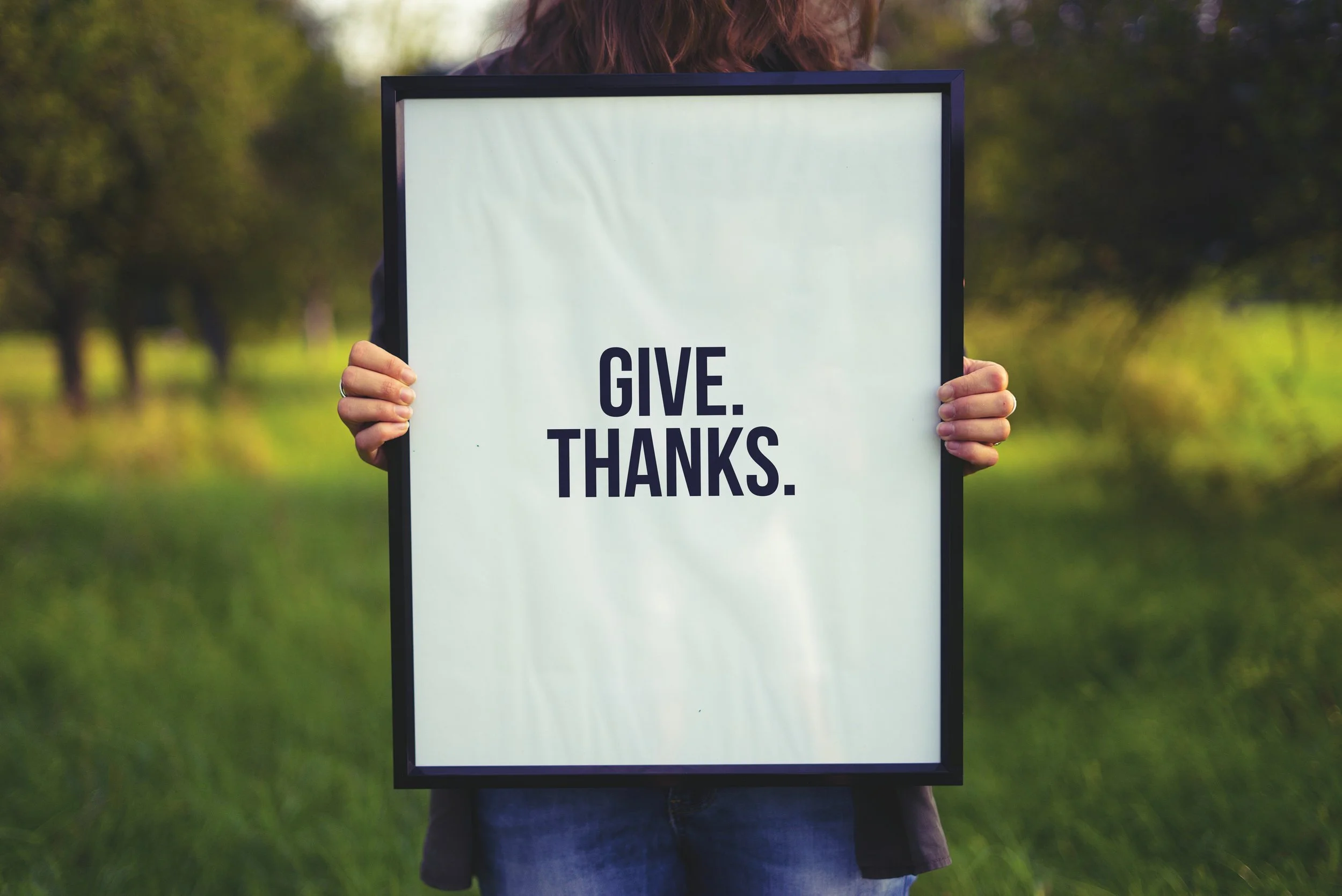
Happy Thanksgiving! This is my favorite holiday. I love the food, the season, the emphasis on giving thanks and being with friends and family. I also got engaged right before Thanksgiving…many moons ago. :)
I think for every Thanksgiving that I’ve spent with my parents, after we eat my dad will introduce the same game, whether it’s just family or we’ve invited friends. It’s an alphabet thankfulness game where one person says something to be thankful for starting with ‘A.’ The next person repeats the ‘A’ thing from person one and adds something for ‘B.’ You move through the alphabet until you have something for every letter. ‘X’ can get tricky but it’s fun to see how creative people can be! This repetition forces you to pay attention and stretches those brain muscles after a full meal.
But it’s not just reciting things we’re thankful for; it’s an acknowledgment of Who those things are from: God. At the beginning of each round, you say, “God is the source of all good things and I’m thankful for….”
Gratitude is a characteristic lacking in society today. People believe they are entitled to everything but don’t need to be thankful for anything. As much as independence can be a good trait, when we are so independent as to think the world revolves around us, we forget we are nothing. All things — big and little — come from our gracious Lord. He is the source of everything, and may we take time to truly be thankful.
Photo by Simon Maage on Unsplash
Should Christians Criticize Each Other?

One thing that blows my mind is how the Christian community relates to the rest of the Christian community. I don’t understand when I see/read “Christians” who make it their life goal to point out how other Christians are misbehaving and being unChristian.
Yes, I acknowledge that Christians sin and are susceptible to temptation of all kinds. And when we sin, we need to be held accountable so we can repent and be restored. But much of the noise going on among Christians today is not calling out sin but denouncing what one side views as unChristian living; ie living counter to the culture.
I’ve seen so much of this recently, mostly centered around politics, but not exclusively. Some big names in Christianity have been slandering other Christians for things like not “loving your neighbor” because Jesus told us to love others and speaking up on cultural issues isn’t being a loving Christian.
I’m not surprised when the world criticizes Christians because Jesus said that if we follow him, it would bring persecution. But when Christians call out their fellow brothers and sisters in the Lord — not to correct sin but to lambast their thinking on clear biblical principles — we have a problem.
The Bible is full of one another statements and the interesting thing I’ve found that people don’t mention about these statements is that they are in reference to other believers. When the Bible says, “Forgive one another, love one another, confess to one another, don’t judge one another…” these are all in the context of Christians to Christians, NOT unbelievers.
Yes, we are to forgive, love, etc. those who are unsaved but with the purpose of sharing the gospel. There is no mention in the Bible of misleading the unsaved from the truth of their sin so they feel better about themselves. It’s been said, “You have to hear the bad news before the good news makes sense.” If people aren’t told they are sinners in need of a Savior, they won’t care that Jesus came to Earth to save them.
When Christians need to criticize other Christians, there is a standard to follow. We have Matthew 18:15-20 which begins with the words, “If your brother sins…” and some manuscripts have the words “against you” making the sin a personal affront. This isn’t permission to say, “That Christian is talking against an issue I care about! I’m going to call him out!” It is for an actual sin issue, not your pet peeve or a perceived slight.
In the most general sense, if you are criticizing another Christian over a non-sin issue, you are discounting the words of I Thess. 5:11 — “So encourage each other and build each other up…”
But what if you think it is a sin issue? Should you jump online and start blowing off steam? Let’s approach it carefully.
First, check the Bible. Are you misrepresenting a passage and making it say something it doesn’t say? Read the entire context. Who was Jesus talking to and about?
Second, pray about it. What is your motivation for the criticism? Do you actually care to see them restored? Are you jumping on a bandwagon with your two cents? Do you know the person and situation personally? Can you address it in private? Are you shooting your comments at a famous person without knowing the full story?
Third, if you believe you really need to say something, do it kindly. The internet and the world are nasty enough. We shouldn’t be name calling, ranting, or tearing down others. Yes, we can point out error. But we don’t have to be rude about it. We can lovingly, patiently seek to win the erring brother through a generous, gracious answer.
Homeschool Year 11!!

Here we are, starting our eleventh year homeschooling! I started with preschool for my oldest and now she is entering high school and we’ve added two more children. It truly is wild.
Each year is different as kids get older and are able to do more. And I always try to listen to what they want to learn about and things they want to change up. No two years look exactly the same.
With a high schooler now, I am being more diligent with keeping track of her grades for transcript purposes. I’m thankful we live in a state that is friendly to homeschoolers and easy to find graduation requirements. I’m very impressed with the work she is accomplishing this year. One of the biggest changes is taking American History in our Co-Op, using the Hillsdale College curriculum. It is a lot of reading! She is also diagramming maps, creating timelines, and reading papers written by the founding fathers. Denison Algebra continues to be a hit and one of the best discoveries for this non math mom. She chose astronomy for her science credit and I’ve been thrilled with the MasterBooks curriculum on that subject.
I didn’t change things up too much with my sixth grader. He is still doing Teaching Textbooks for math, although at his request, I am printing off the homework pages instead of him doing them on the computer. He is studying ancient civilizations for history and it has been completely new territory for him. The hardest part is how to pronounce all those names!! He has really gotten into creative writing this semester and has started writing short adventure stories. It has helped with punctuation and my one rule is no AI help!
My youngest is in second grade and I’m still quite hands-on with her. I read history and science to her and she likes it when I watch her do her phonics work to make sure she understands it. Of all three kids, she enjoys breaks the most, even though it prolongs her school day. So we will often tackle two subjects, play a little or have a snack, and continue on.
I’m very thankful for our schoolroom that allows the kids to have their own desks, all the books in one place, educational games and craft supplies stored nearby, and tucked away so when school is done, we aren’t looking at the mess. Being able to homeschool my kids is something I don’t take for granted and something I truly enjoy doing.
What Migraines Taught Me

Warning: this is a longer post! It’s also one of the more personal posts I’ve written. I don’t post this to gloat in how much I’ve been through or make people feel sorry for me. I wanted to share this as an encouragement, that even in the midst of years of hard, there is always God who loves us and knows us better than we know ourselves. Nothing is wasted or pointless. God is good.
I have a vivid memory of being about 9 years old and having my first migraine. We were at Sunday evening service and my head was pounding. It was so bad, I went into a classroom during the service and crawled under a table to escape every shred of light. I laid there, curled up, until it was time to go home.
That was the first headache memory I have but it wasn’t the last. As I got older, I started reading more and I would often get headaches so I started wearing reading glasses, which helped some.
Moving into high school, life got stressful. I started attending a private school after being homeschooled, which meant spending all day in classrooms, reading from the blackboard or projector, and carrying lots of books. My sophomore year of high school was rough. But I found great friends, settled into a routine, and life continued, including my headaches.
By the time I was in college, I was resigned to the fact that headaches were part of who I was. Nothing seemed to keep them away and getting a headache every afternoon became my normal. I would swallow a few Tylenol between classes and keep going. I became very good at doing what I needed to do, even with a pounding headache. I figured if this was my life, I wasn’t going to miss out on things. I would simply keep going over the pain until I could crash at night.
Interviewing for the school newspaper, rehearsing for and performing in a musical, presentations, speeches, concerts, church. I had headaches/migraines for it all. Granted, I wasn’t taking the best care of myself. I would have to skip lunch for class sometimes, water bottles weren’t an accessory during this time in history so I probably wasn’t drinking as much water as I should. But on the days when I was at home — when I ate three meals a day and had easy access to water — I still got headaches, just less intense. They seemed inevitable.
Years passed, I graduated from college, I got married, I started working full time. During this time, my mom read that certain preservatives can cause migraines, and it proved true for me when one Sunday, I ate honey baked ham and within the hour found myself on the couch in pain. I hoped by cutting out ham, bacon, and anything with sodium nitrate/nitrite my headaches would become manageable. It helped some, but I still spent several days each week with headaches.
At this time, I also visited a neurologist for the first time. He listened none too patiently, prescribed a rescue medicine, and that was it. When I had extreme reactions to the medicine — like passing out and breaking into hives — I decided I’d stick to Tylenol and Ibuprofen. Going to the chiropractor offered no help and I actually felt worse because I would have such throbbing migraines every time I left his office.
It seemed like I had reached the end of all I could do. I started praying for the ability to live with the pain rather than for God to take it away. I’ve always believed that God answers prayers, but not always the way we picture. Sometimes healing in this life doesn’t happen and although it was a hard truth to accept, I decided I was done trying to get away from my migraines and I would learn to manage them and see how God would sustain me.
From my mid 20s to my late 30s, I developed a routine. I learned how severe my headache could get before I really needed pain medicine. I found rubbing peppermint oil on my temples and neck dulled the throbbing. I bought a headache hat {a spandex hat with ice packs sewn in that keeps cold pressure on your temples and neck} and it became the visual cue for my family for how bad I was feeling. I took supplements, electrolytes, cut back on caffeine, and limited how long I was in direct sun when I could.
But when I turned 40, things started changing. My pain was different; it moved from my temples to my jaw and at times it hurt to chew. My bad migraines started lasting longer and I had more days of staying in bed. I would drag myself to the schoolroom, do schoolwork with the kids for a few hours, usually with headache hat on, then crawl back to bed for the afternoon and evening.
My total undoing was my kids. I would lie in bed and hear them reminding each other to be quiet. I would feel them come in and leave a mug of hot tea by the bed, give a quick hug, and rush out. We canceled playdates and delayed planned activities. When we went to the zoo or on a hike, I would come home depleted. Migraines were becoming harder to live with. They had been part of my life for three decades but as my kids got older, I hated having to step out of things and change plans because of my pain. They never said it, but I know they experienced disappointments.
I wrestled with going to a neurologist. Was it unfaithful of me to seek an answer? I thought God’s answer to my prayer for relief had come years before, but would he answer in a different way now? And I had tried so many things. Was it worth circling back and trying again, since my pain had changed? At my regular doctor’s appointment, I mentioned how my migraines were changing and she urged me to see a neurologist. The soonest appointment was six months away so I waited and prayed and continued on.
When the neurologist started asking me questions, I couldn’t keep from crying. The reality of all those years of pain, of missing out on things, of acting like everything was great while my head was swimming came pouring out. He was concerned at the frequency of my headaches and how much they were controlling my day to day life. After various tests, questions, and an MRI, we ruled out anything major and I was put on a beta blocker.
After my previous reaction to medicine, I was skeptical but I kept praying, and I had so many friends and family praying also. Our busy summer began and about two months after I started the prescription, Tommy asked, “When was the last time you took Tylenol?” I looked at him, bewildered. “I don’t remember.” I thought back and I suddenly realized I had been free of head pain. Not just bad migraines, but my daily headaches were gone! Friends at church noticed my eyes weren’t glazed over in pain all the time. My kids noticed I didn’t need to retreat to a dark room constantly.
There are still a few things that can trigger my headaches. Barometric pressure changes and fluctuating hormones are still problems but those are not constant or often, and the pain is usually controllable. For the first summer I can remember, I’ve been able to go on walks, help with VBS, and work in the garden without headaches. I get my work done and still feel well enough to run errands or play with my kids. It has been lifechanging.
Does this mean my three decades of pain was wasted? That my life wasn’t all it could have been? No, I don’t think so. As much as I wanted the pain gone and as grateful as I am to have relief now, I learned so much in the suffering. I saw God helping me when I genuinely had no physical or mental strength myself. Allowing me to still teach my kids, giving me Tommy who would come home and fix dinner when I was in bed, having my parents close to watch kids when needed. I came to the end of myself many times but God’s grace proved to be greater and his strength was evident in my weakness.
God also brought some wonderful encouragers into my life. My sister in law takes special notice of my pain levels since she suffers from migraines also, friends pray for me and send me notes of encouragement, my family provides preservative free eating options at our gatherings. I have learned we need to be in community with Christians and be honest about our struggles. If we suffer alone, we won’t have anyone who knows we need support. We will miss out on the blessing of letting others help us.
The last thing I’ve noticed is how my kids have responded. I always felt guilty that my pain was keeping them from a full childhood. Instead, I’ve seen how caring and thoughtful they can be. I remember when my youngest was a toddler, and I would lie on the floor with my eyes closed while the older siblings kept her occupied nearby. Times they’ve asked what they can get me so I don’t have to get up. Moving schoolwork onto my bed so they can read without me sitting up. When my son got a headache once, he asked, “Is this how you always feel?” and gave me a big hug.
I have no guarantee that the beta blocker is a long term solution but I’m thankful for the way it’s currently helping. I know people take it for years with positive results. For now, I praise God for the unexpected ways he answers prayers, for the grace I know he gives in whatever happens next, and for the ability to look back on how he has sustained me.
Photo by 85GB photo on Unsplash
Our Refuge

“I just wish the world was safe again.”
The thought came suddenly but was dispelled just as fast. When has the world ever been safe?
We were vacationing in Florida when the news of October 7 hit. It seemed a paradox that we were jumping in beach waves and relaxing by the pool while somewhere else in the world families were being torn apart with bullets and kidnapping.
I sat on the porch after watching small clips of the news — about all I could take — and read a few Psalms. Psalm 61 stood out in the midst of everything and I read it multiple times.
To the choirmaster: with stringed instruments. Of David.
1Hear my cry, O God,
listen to my prayer;
2from the end of the earth I call to you
when my heart is faint.
Lead me to the rock
that is higher than I,
3for you have been my refuge,
a strong tower against the enemy.
4Let me dwell in your tent forever!
Let me take refuge under the shelter of your wings! Selah
5For you, O God, have heard my vows;
you have given me the heritage of those who fear your name.
6Prolong the life of the king;
may his years endure to all generations!
7May he be enthroned forever before God;
appoint steadfast love and faithfulness to watch over him!
8So will I ever sing praises to your name,
as I perform my vows day after day.
Verse four caught my attention with the lovely picture of the nearness and protection of God. To dwell goes along with word abiding and in his tent refers to the tabernacle, the very presence of God. This God who created everything protects us as a mother bird spreads her wings over her chicks. We have a safe refuge because of his watchful care.
This doesn’t mean the world ceases to be a frightening, unsafe place or that we never face trials and heartache. But in moments of anxiety, when chaos and fear seem to be winning, we can run to the Rock of our Salvation. We can find peace and hope beneath his comfort and care.
The world will never be safe or without trouble as long as sin is here. But we know this temporal place isn’t the end. It isn’t our hope or best life. We live for eternity where we will dwell with God forever.
Photo by Dulcey Lima on Unsplash
Craving Influence

I’ve recently read several things about friendship and influencing others. We tend to have the idea of big, grand gestures but what if true influence is more about small, quiet moments of simply showing up when needed?
Last Christmas was quite different from past ones. My family joked that it was the Christmas of the influencer. Without intending to, the opening of most of the presents I received or gave were followed with, “So I watched a lady on YouTube…” or “This ad popped up on Instagram…”
I wasn’t looking to have an Influencer Christmas or trying to buy only things I had seen advertised on social media. But it suddenly became clear that many of the items I had added to my wish list or cart were there purely at the recommendation of someone I didn’t know personally but had seen on the Internet.
There isn’t anything necessarily wrong with this. But it does show how easily we can be swayed by others and how quickly we follow advice when it sounds credible.
Influence is a powerful thing. Nowadays, anyone can become an “influencer” for good or bad. Most of the time, we think of influencers as telling us which Amazon clothes are the best, what deals will hit on Black Friday, or maybe the newest life hack. But influence is so much more. It’s encouraging people to think, act, live a certain way, to hold sway over what a person believes is normal or acceptable. I would say that most cultural influencers have no business speaking into the lives of others.
But that’s part of the problem. We choose who influences us. It’s not a passive act, like we might want to think. We decide who to listen to and whose advice to take. We continue to watch the channels and listen to the podcasts and share the viral hacks. And with every choice, we are demonstrating what is important and valuable to us. Who or what holds sway over our decisions.
I have noticed that in this noisy, busy world of everyone connected all the time via the Internet, what most people crave isn’t someone else to listen to but someone to show interest in them. We are a self-centered, narcissistic society and sometimes, the reason we latch onto someone and start listening is because we believe they are authentic, relatable, and similar to us.
And we might even value the role of influencer ourselves. It makes us feel good to know people are listening to our opinion, advice, and commentary. But we don’t need to have thousands of followers or hundreds of clicks to influence someone, for good or evil. Look around. The people you see everyday — whether at work or home — are influenced by your decisions, values, and attitude.
We don’t need to make money at it to influence someone. It’s in small things; listening to a grieving friend, putting your phone aside while your children talk about their day, remembering a neighbor’s birthday with a bunch of flowers, checking in with a friend over text, laughing with your family over a special memory.
Each of these little moments show who we are prioritizing and speak volumes more than all the ads on Facebook. Stop and consider your corners of influence. Ask who you are allowing to influence you. And never take small moments for granted.
Photo by Mats Havia on Unsplash
Everyday Beauty

We are becoming a people harder and harder to please. Because we are saturated with ideas, information, and images from across the world, we expect things on demand.
High speed Internet, food delivery, buy online. Even our art and architecture has suffered. Speed is the great factor. How fast can I shed these pounds, clean the house, listen to a book? We think speed means we will get more accomplished and that is the sign of success. No matter that the work isn’t done well, that we don’t put our best effort forth trying to get through all the things. Who has time for beauty in a go, go, go world?
I would argue that we need moments of beauty. Something to turn our gaze on and marvel at, both the talent of the craftsmen and the work itself. Of all the things God created, humans are the only ones he gave the ability to create and enjoy the creation. We alone can recognize the unique work put into the Taj Mahal or St. Paul’s Cathedral. We can wonder at the skill displayed in the Sistine Chapel ceiling or the sculptures of DaVinci. We can stare at the changing colors of a sunset or the grandeur of mountains and realize how small we are.
Perfection isn’t listed in the definition of beauty. The dictionary defines beauty as being pleasing to the mind or senses. Often something is beautiful despite its imperfection, like a tree with oddly angling limbs.
We define many things as beautiful — people, art, words, things — but we don’t all see beauty the same way. For some people, it takes a great talent and larger than life effort. For others beauty equals flawlessness, perfection. But whatever we choose to call “beautiful,” I’m afraid it’s becoming more rare. In part because, as mentioned above, we have become too busy to notice or appreciate it. And we are too busy to create it.
Beauty shouldn’t have to be extreme for us to appreciate. Beauty can be found in simple things. Birds flocking to a feeder, children playing a game, sunlight dancing off piles of snow. The challenge is to look around and notice it. Imagine someone walking through the Hall of Mirrors in Versailles Palace and only noticing the flaws in her own reflection in all the mirrors instead of the room and mirrors themselves. We would think she’s ridiculous!
But going through our day gloomy, downcast, and negative when we are surrounded by creation is just as ridiculous. Or talking ourselves out of creative pursuits because we aren’t as talented as someone else, instead of grabbing a brush or pen or needle and thread and just trying!
Photo by Paige Cody on Unsplash
Jesus Died for...All

My kids and I went to see The King of Kings movie this week. I didn’t know much about it except for reading one review. The premise is Charles Dickens {yes, the novelist} wants to teach his son about the greatest King who ever lived. So he tells the story of Jesus, from birth to resurrection. As he hears the story, the boy “lives” the scenes his father is describing, trying to warn the family that Herod is killing babies, showing Mary that Jesus is teaching in the temple, etc.
At first, the intrusion into the biblical narrative of a Victorian dressed boy and his cat was a little jarring. But as the boy “experiences” miracles, the Garden of Gethsemane, and the crucifixion, the movie watcher is also welcomed into the narrative; maybe to experience these Bible events in a fresh way.
While this post is not an endorsement for the film {it does have some biblical inaccuracies}, it did make me consider a few things through a new lens. And that’s the lens of people — the individuals who lived what we are prone to breeze through in our Bible reading.
The scenes portrayed are ones I knew in an instant: the blind man healed, the paralytic lowered through the roof, Jesus walking on water and feeding thousands. But thinking what it would have been like to experience them in person made me pause. Especially in one scene: when the woman caught in adultery is brought to Jesus.
In the movie, you see the crowd grabbing rocks, yelling it is lawful to stone her for her sin, the Pharisees smirking, the woman crying. Jesus stands from writing in the dirt and simply says, “Let the person who has never sinned throw the first stone.” In the movie, he looks around as the angry faces in the crowd turn to surprise, confusion, guilt. Hands lower, rocks fall to the ground, and everyone walks away.
That realization that we have all sinned. That there is no ranking in God’s eyes. Sin separates us from the perfectly holy God. Lying is a sin just as pride is, just as adultery is, just as murder is, just as idolatry is. We have no merit or goodness on our own. And that is why Jesus came. For all sinners, because we need a Savior.
It’s hard to believe I need to say this…but that person you disagree with politically is saved by the same sacrifice of Jesus that saved you. Those family members who don’t follow the same life rules you do, Jesus died for their sins when he died for yours. Salvation isn’t limited to who we think deserves it. It’s an open invitation that every person has to choose to accept but that God freely offers to all.
If you are trying to do good works, be a better person, reach God on your own merit, please stop. Jesus died for you. Maybe you don’t feel worthy of his sacrifice. Maybe you’ve rejected him in the past. Come now. Repent of your sins, ask Jesus to save you, admit you are a sinner in desperate need of a Savior. Meet the King of Kings at the foot of the cross.
Photo by Duncan Sanchez on Unsplash